You Shouldn’t Have to Get Lucky to Survive Anaphylaxis
Recently, I witnessed something on a boat that I haven’t been able to stop thinking about.
Someone began experiencing a severe allergic reaction.
We were out on the water—not in a hospital, doctor’s office or somewhere emergency help could reach us immediately. When anaphylaxis happens, minutes matter.
Thankfully, someone on the boat had epinephrine.
It was administered, and the person survived.
But afterward, I couldn’t stop thinking about one question:
What if no one had had epinephrine?
The outcome could have been very different.
And perhaps the bigger question is this:
Why should someone’s survival from anaphylaxis depend on getting lucky enough that someone nearby happens to have epinephrine?
We’ve Already Embraced Public-Access Lifesaving Tools
Think about how our approach to other life-threatening emergencies has changed.
We put automated external defibrillators (AEDs) in airports, schools, gyms, churches, workplaces and other public spaces. We do this because when someone experiences sudden cardiac arrest, every minute matters. We don’t want to wait for EMS to arrive before a potentially lifesaving shock can be delivered.
We’ve also dramatically expanded access to naloxone, commonly known by the brand name Narcan, so bystanders can intervene during a suspected opioid overdose.
In 2023, the FDA approved Narcan nasal spray for over-the-counter use, making it possible to purchase the medication without a prescription.
The reasoning behind public access is simple:
When someone’s life depends on receiving the right intervention quickly, having that intervention nearby can save a life.
I believe it’s time to have a similar conversation about epinephrine.
Anaphylaxis Is an Important Part of First Aid Training
Anaphylaxis is a severe allergic reaction that can progress rapidly and become life-threatening. Epinephrine is the first-line treatment for anaphylaxis, and delaying its administration can lead to worse outcomes.
Recognizing and responding to a severe allergic reaction is also an important skill taught during CPR and First Aid training.
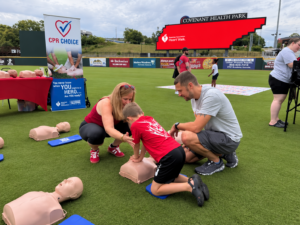
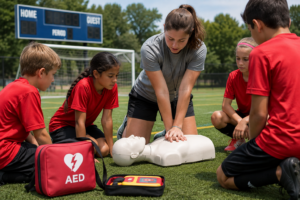
In our CPR Choice First Aid certification courses, students learn how to recognize signs and symptoms of anaphylaxis, activate EMS and assist with or administer epinephrine according to their training and applicable protocols.
But the emergency may not end there.
If someone experiencing anaphylaxis becomes unresponsive and is not breathing normally, rescuers may need to begin CPR and use an AED while waiting for EMS to arrive.
That’s why CPR, AED and First Aid training work together.
Emergency response isn’t about memorizing one skill for one situation. It’s about recognizing a life-threatening emergency, taking action quickly and knowing what to do if the person’s condition gets worse.
Of course, even the best-trained bystander can’t administer emergency epinephrine if none is available.
And that’s the part I believe deserves more attention.
Neffy: A New Needle-Free Epinephrine Option
There’s another development that makes this conversation particularly timely.
The FDA has approved neffy®, an epinephrine nasal spray, for the emergency treatment of allergic reactions, including anaphylaxis.
Instead of requiring an injection into the thigh, epinephrine can now be delivered through the nose.
That’s significant.
One barrier to bystander emergency care can be fear or hesitation. Someone may be uncomfortable administering an injection to another person during an emergency.
A nasal spray offers a needle-free method of delivering epinephrine and uses a delivery method that has become increasingly familiar to the public through medications such as naloxone.
Neffy is currently a prescription medication, so this doesn’t mean anyone can simply purchase it over the counter and start placing it in public spaces without considering applicable laws and protocols.
But its arrival should make us ask a bigger question.
Could Epinephrine Become the Next Public-Access Lifesaving Medication?
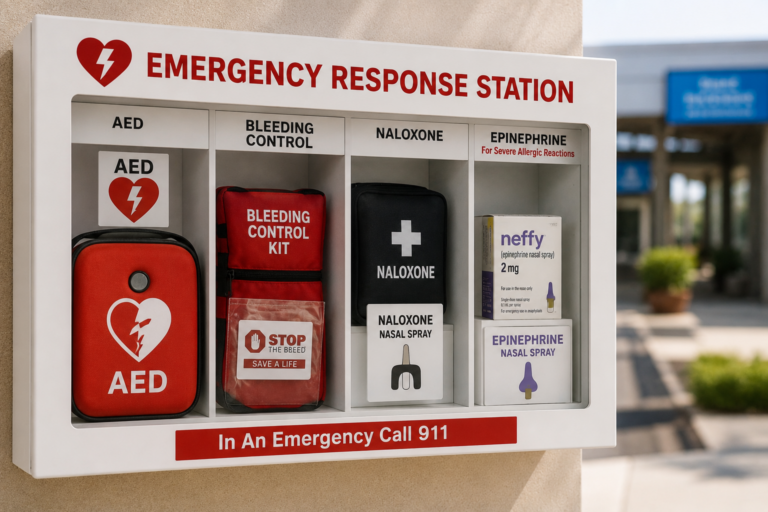
Imagine walking into a school, sports complex, restaurant, marina, airport, church, gym or workplace and seeing an emergency response station containing:
AED. Bleeding-control supplies. Naloxone. Epinephrine.
Not epinephrine prescribed to one particular employee, student or customer.
Stock emergency epinephrine available when an unexpected, life-threatening allergic reaction occurs.
The idea of stock epinephrine isn’t new. Schools and other organizations in many states already have mechanisms that allow undesignated epinephrine to be available for emergencies.
But access isn’t universal, and the rules governing who can obtain, stock and administer epinephrine vary.
The experience I witnessed on the lake made me wonder how many other emergencies happen in places where epinephrine simply isn’t available.
But Isn’t Epinephrine a Powerful Medication?
Yes. Epinephrine is a powerful medication and can have cardiovascular effects.
But that’s also part of how it works to reverse the life-threatening effects of anaphylaxis.
Current medical guidance identifies epinephrine as the first-line treatment for anaphylaxis. Serious adverse reactions from appropriately administered epinephrine are considered rare, and delaying epinephrine during anaphylaxis can be far more dangerous.
FDA prescribing information for neffy lists no contraindications.
Public access doesn’t have to mean careless access.
AEDs are medical devices capable of delivering an electrical shock. Naloxone is a medication. We didn’t respond to those risks by deciding the public shouldn’t have access to them.
Instead, we developed simple instructions, training, protocols and public education to help ordinary people respond appropriately while professional emergency care is on the way.
Why couldn’t we explore a similar model for epinephrine?
Public Access Would Require Education and the Right Safeguards
There are legitimate questions that would need to be addressed before public-access epinephrine could become commonplace.
Who can purchase and stock it? Who is legally permitted to administer it? What training should be provided? Where should it be stored? How should expiration dates be monitored? What liability protections are appropriate? How do state stock-epinephrine laws need to evolve? And could an epinephrine product eventually meet FDA requirements for over-the-counter availability?
Those are important conversations.
But they shouldn’t stop us from asking the question.
They should help us determine how to do it safely.
Training and Access Save Lives
I’ve spent years teaching people how to respond to emergencies, and one principle comes up again and again:
The right intervention only saves a life if someone can get to it in time.
An AED locked in an office doesn’t help the person experiencing cardiac arrest across the building.
Naloxone miles away doesn’t help the person experiencing an opioid overdose in front of you.
And epinephrine that nobody nearby has doesn’t help someone experiencing a rapidly progressing anaphylactic reaction.
The person I saw on the lake was fortunate.
Someone had epinephrine.
But survival from a time-critical emergency shouldn’t have to depend on luck.
We’ve made tremendous progress putting AEDs into our communities. We’ve recognized the lifesaving value of making naloxone more accessible.
Maybe public-access epinephrine should be next.
Be Prepared to Respond
Making lifesaving equipment and medications more accessible is only part of the solution. We also need people who are confident enough to use them.
That’s why CPR, AED and First Aid training matters.
A quality First Aid course can prepare you to recognize emergencies such as severe allergic reactions and anaphylaxis, understand the role of epinephrine, activate EMS and provide appropriate care while professional help is on the way.
CPR and AED training prepares you to act if an emergency progresses to cardiac arrest.
At CPR Choice, we provide CPR, AED, First Aid and Basic Life Support (BLS) certification and training for individuals, workplaces, healthcare professionals and organizations.
Our goal isn’t simply to help someone earn a certification card. It’s to create communities where lifesaving equipment is accessible and people are prepared to respond.
Because whether the emergency is cardiac arrest, choking, anaphylaxis, severe bleeding or an opioid overdose, the person standing nearby may be the most important person in the room.
Equipment saves lives. Medication saves lives. Training saves lives. But only when they’re available when someone needs them.
What do you think?
Should emergency epinephrine become as readily accessible as AEDs and naloxone?